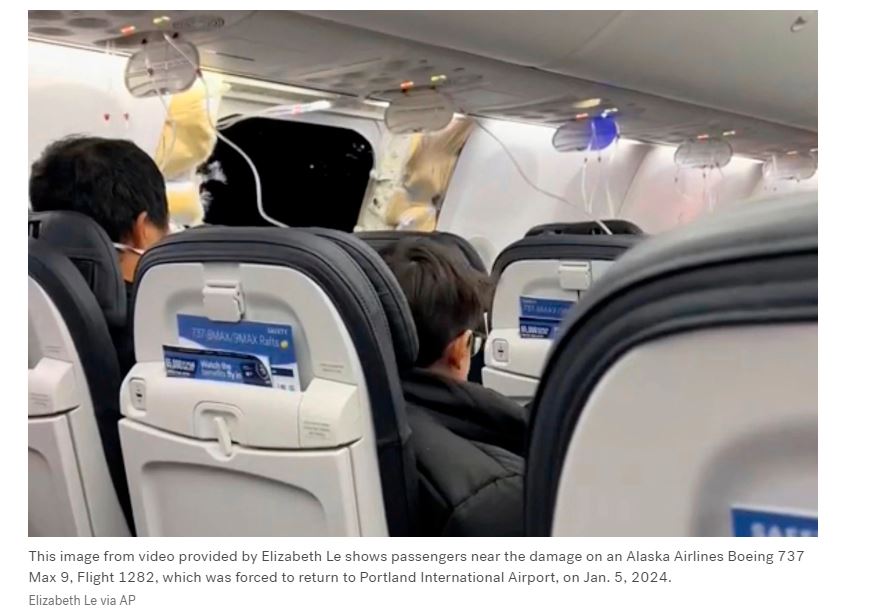
A door plug fell out of an Alaska Airlines flight Friday, NTSB officials said.
by Kevin Shalvey
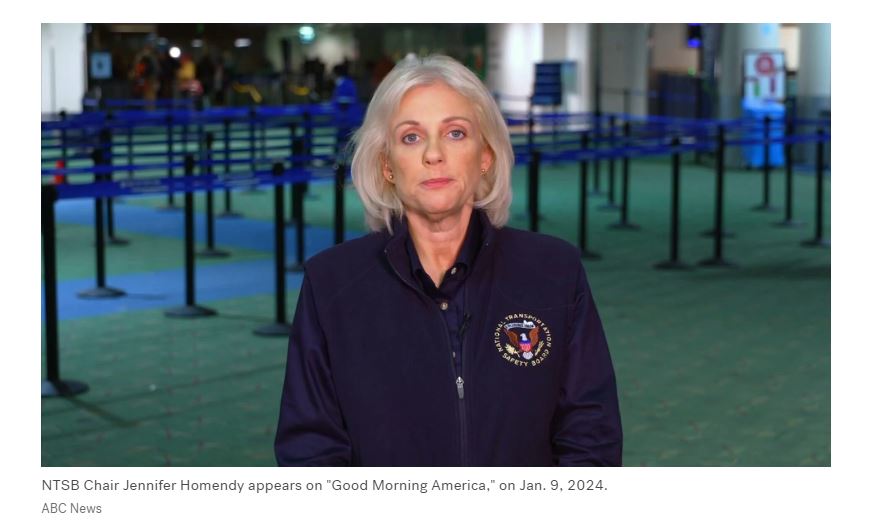
The focus of the investigation into Friday’s midair emergency on an Alaska Airlines flight is focused on the single aircraft, but could be broadened as the National Transportation Safety Board learns more, board Chief Jennifer Homendy said.
“However, at some point we may need to go broader. But right now we have to figure out how this occurred with this aircraft,” Homendy said Tuesday on ABC News’ “Good Morning America.”
The door plug fell off the plane, a Boeing 737 Max 9, around 5:11 p.m. local time Friday as the aircraft with 171 passengers, including three babies and four unaccompanied minors, had climbed to 16,000 feet after taking off from Portland International Airport, according to the NTSB.
The Federal Aviation Administration said Tuesday, “Every Boeing 737-9 Max with a plug door will remain grounded until the FAA finds each can safely return to operation.”
“The safety of the flying public, not speed, will determine the timeline for returning the Boeing 737-9 Max to service,” the FAA said.
Boeing said it continues to be in “close contact” with its customers and the FAA about required inspections of certain 737 Max 9 planes.
“As part of the process, we are making updates based on their feedback and requirements,” the company said.
The fittings at the top of the door plug fractured, Homendy said. The NTSB examination has shown that those fittings were fractured, allowing the plug door to move upward and outward, she said.
“We don’t know if the bolts were loose. We don’t know if bolts were in there fractured or possibly the bolts weren’t there at all,” she said. “We have to determine that back in our laboratory.”
On Monday, United Airlines said it had found loose bolts on its 737 Max 9 fleet during inspections ordered after Friday’s incident involving an Alaska Airlines flight.
The Federal Aviation Administration said Saturday it was temporarily grounding certain Boeing 737 MAX 9 aircraft operated by U.S. airlines or in U.S. territory until they were inspected. The FAA said the pause would affect about 171 planes worldwide.
Homendy said Tuesday she would feel safe flying on a 737 Max 9 now.
“I would feel safe flying right now,” Homendy said. “Our aviation system is the safest in the world.”
Aviation expert speaks on what caused door plug to fall off Alaska Airlines jet
The plane’s door plug fell off the aircraft at 16,000 feet, officials said.
by Bill Hutchinson
As federal investigators seek answers into how a door plug detached from the fuselage of an Alaska Airlines aircraft prompting a midair emergency and the temporary national grounding of Boeing 737 Max 9 jets globally, an aviation expert told ABC News Monday that he suspects investigators will be looking closely at the Boeing assembly line for the possible cause of the incident.
On Monday, United Airlines said it had found loose bolts on its 737 Max 9 fleet during inspections ordered after Friday’s incident involving an Alaska Airlines flight. United wouldn’t say how many planes had loose bolts but added that the emergency inspection caused it to cancel at least 200 Max 9 flights on Monday and that more cancellations are expected on Tuesday.
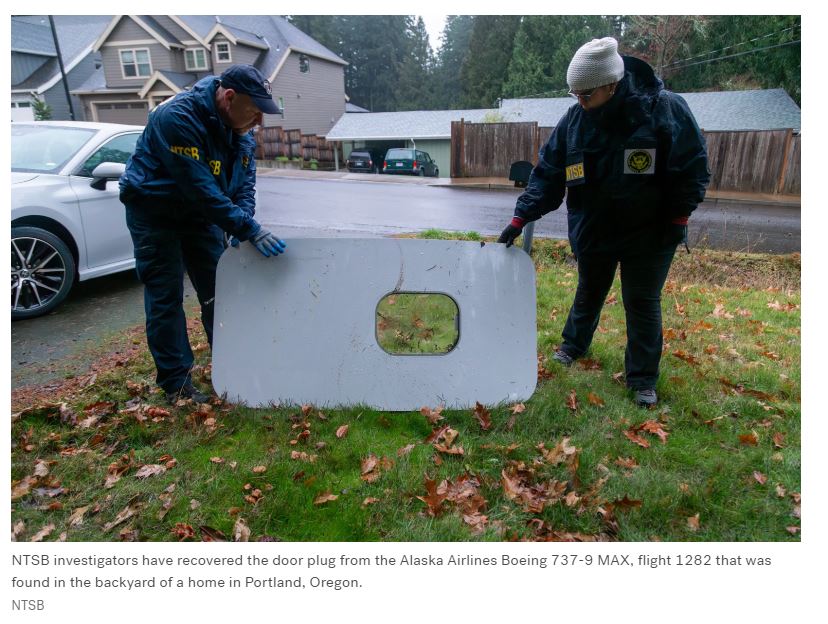
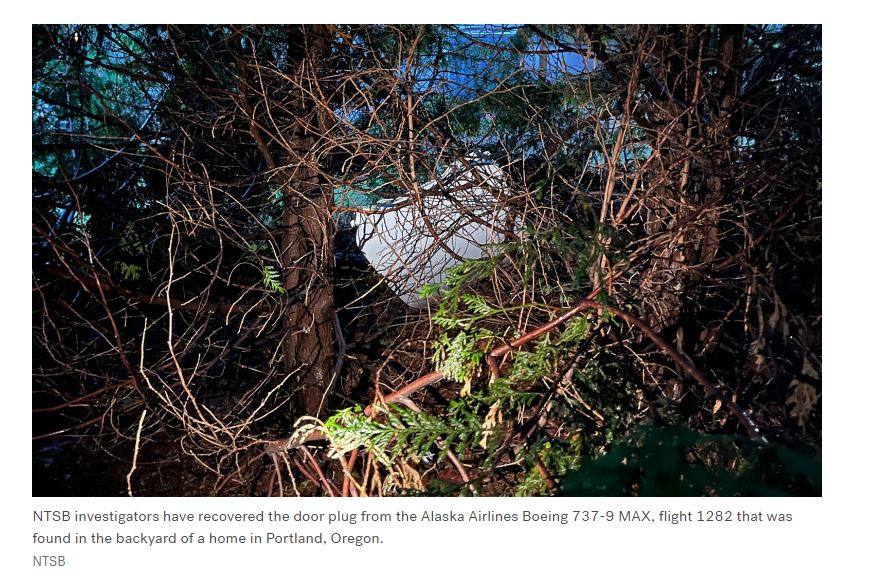
Investigators from the National Transportation Safety Board said they recovered the door plug that fell off Alaska Airlines Flight 1282, giving them the key piece of evidence which they are examining with a laboratory microscope.
The plug, measuring 26-by-46 inches and weighing 63 pounds, was discovered intact Sunday evening in the backyard of a Portland, Oregon, teacher’s home, according to NTSB officials.
The part fell off the plane, a Boeing 737 Max 9, around 5:11 p.m. Pacific Standard Time Friday as the aircraft with 171 passengers, including three babies and four unaccompanied minors, had climbed to 16,000 feet after taking off from Portland International Airport, according to the NTSB.
The incident caused the plane, which was destined for Ontario, California, to return to Portland International Airport to make an emergency landing.
The door plug is used to seal unused exits on planes and, according to a diagram released by the NTSB, is attached to the plane with a series of bolts, cables and stop pads.
The discovery of the missing door plug came shortly after NTSB Chair Jennifer Homendy announced at a news conference that the investigation found three previous incidents on the same Alaska Airlines plane where the auto pressurization fail light illuminated during flights on Dec. 7, Jan. 3 and Jan. 4.
“In these previous flights after the light illuminated, they flipped the switch to alt mode, which is normal. There’s a backup. It was very benign. Nothing occurred,” Homendy said.
It remains unclear if there is a correlation between the auto pressurization light illuminating and the door plug blowing out, Homendy said. Alaska Airlines ordered that the aircraft not be flown to Hawaii over water and restricted it to overland use “so if some light did illuminate, it could return quickly to an airport,” she said.

John Nance, an ABC News aviation analyst, said he doesn’t believe the auto pressurization light coming on and the door falling off the aircraft are connected.
“If it was leaking, it would be making a terrible squeal,” said Nance, adding that he had not heard of such a sound being reported before the door plug incident.
The door plug, which was meant to be a permanent seal of the additional unused exit doors, is usually not wired to a control panel to alert the crew of a pressure problem, Nance said. He added that the only way Alaska Airlines maintenance crews could have inspected the plug would have been to remove it.
Nance noted that Alaska Airlines had only received the aircraft from Boeing on Oct. 31.
“More than likely, if [Alaska Airlines] maintenance didn’t have any reason to go into that heavy maintenance in the three months since the airplane was delivered, then very likely this came off the line at Boeing,” Nance said. “Boeing should be chewing their fingernails this morning because I think that’s greatest likelihood. But I could be entirely wrong.”
Another possible scenario is a structural failure in the plug in one form or another, he said.
“That’s a little hard to see if you’ve got four bolts holding it in place because you’d almost have it split in two. The initial indication that we have is that it was found whole,” Nance said.
“If it was an inherent failure of the door plug, that could get very serious very quick because you might have to have to re-engineer the plugs,” Nance said.
Sunday evening, Boeing CEO Dave Calhoun announced he canceled a two-day leadership summit and instead will hold an all-employee safety meeting from the 737 factory in Renton, Washington on Tuesday. Calhoun also sent out a company-wide memo to staff addressing the incident and ensuring that safety is a top priority.
“When it comes to the safety of our products and services, every decision and every action matters,” Calhoun said in his statement. “And when serious accidents like this occur, it is critical for us to work transparently with our customers and regulators to understand and address the causes of the event, and to ensure they don’t happen again. This is and must be the focus of our team right now.”
On Monday, Boeing issued a statement in response to United Airlines announcing the inspection of its 737 Max 9 jets had found “bolts that needed additional tightening.”
“As operators conduct the required inspections, we are staying in close contact with them and will help address any and all findings. We are committed to ensuring every Boeing airplane meets design specifications and the highest safety and quality standards. We regret the impact this has had on our customers and their passengers,” Boeing’s statement said.
The incident prompted the Federal Aviation Administration to order that all 737 Max 9 aircraft operating in the United States remain grounded “until the FAA is satisfied that they are safe.”
Nance said he supports the FAA’s decision to ground 737 Max 9 jets “so we can make sure that we don’t have something sitting out there like a ticking time bomb ready to go and do it again.”
It was “miraculous” that no one was injured in the incident and no passengers were sitting in seats 26 A and B, where the blown-out door plug was located, Nance added.
“We very well likely could have lost whoever was sitting in 26 A and B if they had been there without their seatbelts,” Nance said. “If this had been at 39,000 or 40,000 feet, a lot more stuff would have gone out and anybody who wasn’t tied in might have gone out as well.”
Nance said that now that the door plug has been found, he is “100% confident” that the NTSB will determine a cause quickly.
“These guys are absolute wizards,” Nance said of the NTSB investigators. “If any metal scraped against any other metal, they’ll find it, including knowing exactly where it came from. I seriously doubt there will be any speculative nature of the final understanding of this, which will come very rapidly because they’ve got to get these other airplanes back in service.”
Michael Huerta, a former FAA administrator, told ABC News that the flying public should remain patient and let the NTSB investigation play out.
“At this point in the investigation, a lot of times what you’re going to hear early on in the investigation will either be incomplete or in some instances wrong,” Huerta said. “So, you have to give the investigators time and space to kind of figure out what the full scope of things are. The NTSB is a very professional organization, and they will get to the root cause.”
Huerta added, “What we don’t know is whether this was a freak incident or whether there was some kind of factory defect in the way the door was originally installed.”
#TravelThursdays, #VintageDava, #Boeing737, #Airplane, #NTSB, #Portland, #AlaskaAirlines, #UnitedAirlines, #Investigation
Connect with Me At:
https://www.tumblr.com/blog/vintagedava
https://www.facebook.com/VintageDava/
https://www.instagram.com/vintagedava/
https://www.threads.net/@vintagedava
 Vintage Dava