WHERE SEAS ARE RISING AT ALARMING SPEED
By Chris Mooney, Brady Dennis, Kevin Crowe. and Joh Muyskens
One of the most rapid sea level surges on Earth is besieging the American South, forcing a reckoning for coastal communities across eight U.S. states, a Washington Post analysis has found.
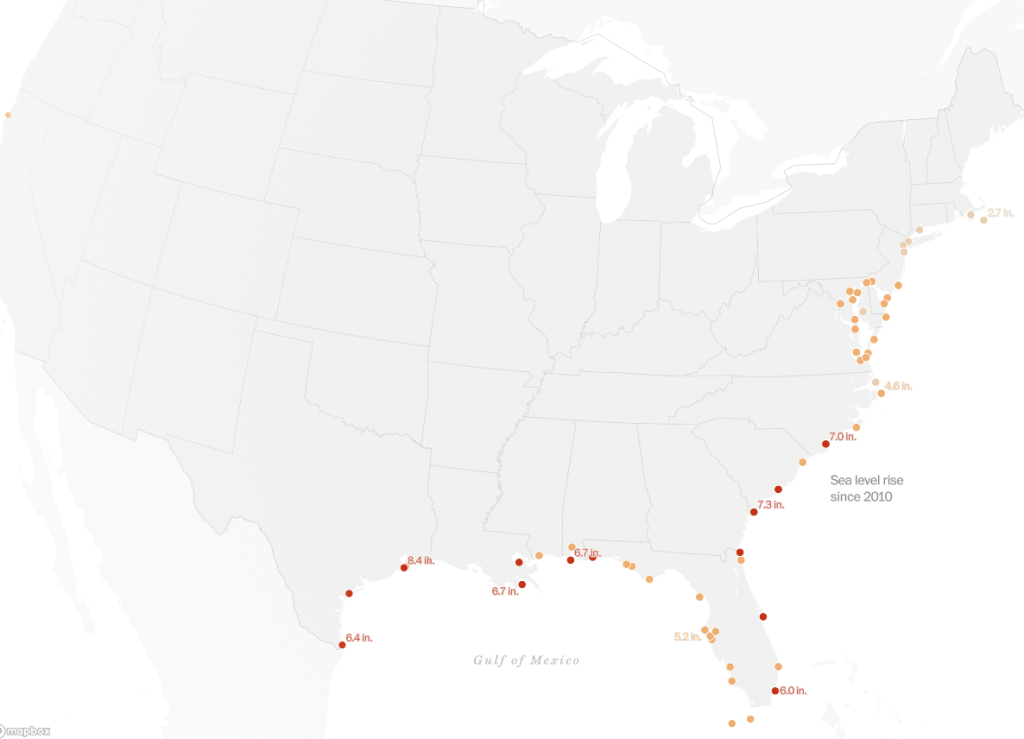
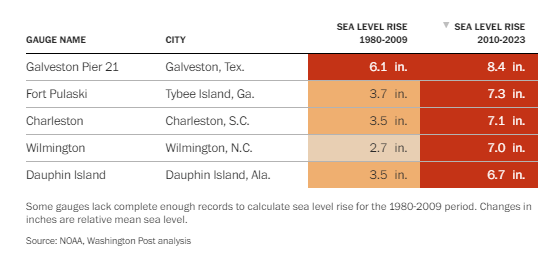
At more than a dozen tidegauges spanning from Texas to North Carolina,sea levels are at least 6 inches higher than they were in 2010 — a change similar to what occurred over the previous five decades.
Scientists are documenting a barrage of impacts — ones, they say, that will confront an even larger swath of U.S. coastal communities in the coming decades — even as they try to decipher the precise causes of this recent surge.
The Gulf of Mexicohas experienced twice the global average rate of sea level rise since 2010, a Post analysis of satellite data shows. Few other places on the planet have seen similar rates of increase, such as the North Sea near the United Kingdom.
“Since 2010, it’s very abnormal and unprecedented,” said Jianjun Yin, a climate scientist at the University of Arizona who has studied the changes. While it is possible the swift rate of sea level rise could eventually taper, the higher water that has already arrived in recent years is here to stay.
“It’s irreversible,” he said.
As waters rise, Louisiana’s wetlands — the state’s natural barrier against major storms — are in a state of “drowning.” Choked septic systems are failing and threatening to contaminatewaterways. Insurance companies are raising rates, limiting policies or evenbailing in some places,casting uncertainty over future home values in flood-prone areas.
Roads increasingly are falling below the highest tides, leaving drivers stuck in repeated delays, or forcing them to slog through salt water to reach homes, schools, work and places of worship. In some communities, researchers and public officials fear, rising waters could periodically cut off some people from essential services such as medical aid.
While much planning and money have gone toward blunting the impact of catastrophic hurricanes, experts say it is the accumulation of myriad smaller-scale impacts from rising water levels that is the newer, more insidious challenge — and the one that ultimately will become the most difficult to cope with.
“To me, here’s the story: We are preparing for the wrong disaster almost everywhere,” said Rob Young, a Western Carolina University professor and director of the Program for the Study of Developed Shorelines.
“These smaller changes will be a greater threat over time than the next hurricane, no question about it,” Young said.
In December, Charleston, S.C., saw its fourth-highest water level since measurements began in 1899. It was the first time on record that seas had been that high without a hurricane. A winter storm that coincided with the elevatedocean left dozens of streets closed. One resident drowned in her car. Hundreds of vehicles were damaged or destroyed, including some thatwere inundated in a cruise terminal parking lot.
The average sea level at Charleston has risen by 7 inches since 2010, four times the rate of the previous 30 years.
Jacksonville, Fla., where seas rose 6 inches in the past 14 years, recently studied its vulnerability. It found that more than a quarter of major roads have the potential to become inaccessible to emergency response vehicles amid flooding, and the number of residents who face flood risks could more than triple in coming decades.
Galveston, Tex., has experienced an extraordinary rate of sea level rise — 8 inches in 14 years. Experts say it has been exacerbated by fast-sinking land. High-tide floods have struck at least 141 times since 2015, and scientists project their frequency will grow rapidly. Officials are planning to install several huge pump stations in coming years, largely funded through federal grants. The city manager expects each pump to cost more than $60 million — a figure that could eclipse the city’s annual tax revenue.
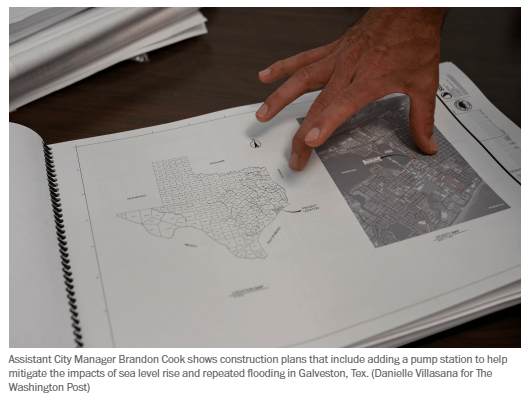
For this analysis, The Post relied on tide gauge data, which reflects the rise in sea level and sinking of land. Satellite data, which solely measures the height of oceans, was used for global measurements.
“The phenomenon is so new, we still don’t necessarily even have the vocabulary for it,” Christopher Piecuch, a sea level scientist at Woods Hole Oceanographic Institution, said of the unrelenting nature of flooding confronting more and more communities.“This is something that quite literally didn’t happen two decades ago.”
But it undoubtedly is happening now. The number of high-tide floods is rapidly increasing in the region, with incidents happening five times as often as they did in 1990, said William Sweet, an oceanographer for the National Oceanic and Atmospheric Administration.
“We’re seeing flooding in a way that we haven’t seen before,” said Sweet, who leads the agency’s high-tide flooding assessments. “That is just the statistics doing the talking.”
Projections suggest that the flooding of today will look modest compared with what lies ahead. High-tide floods in the region areexpected to strike 15 times more frequently in 2050 than they did in 2020, Sweet said.
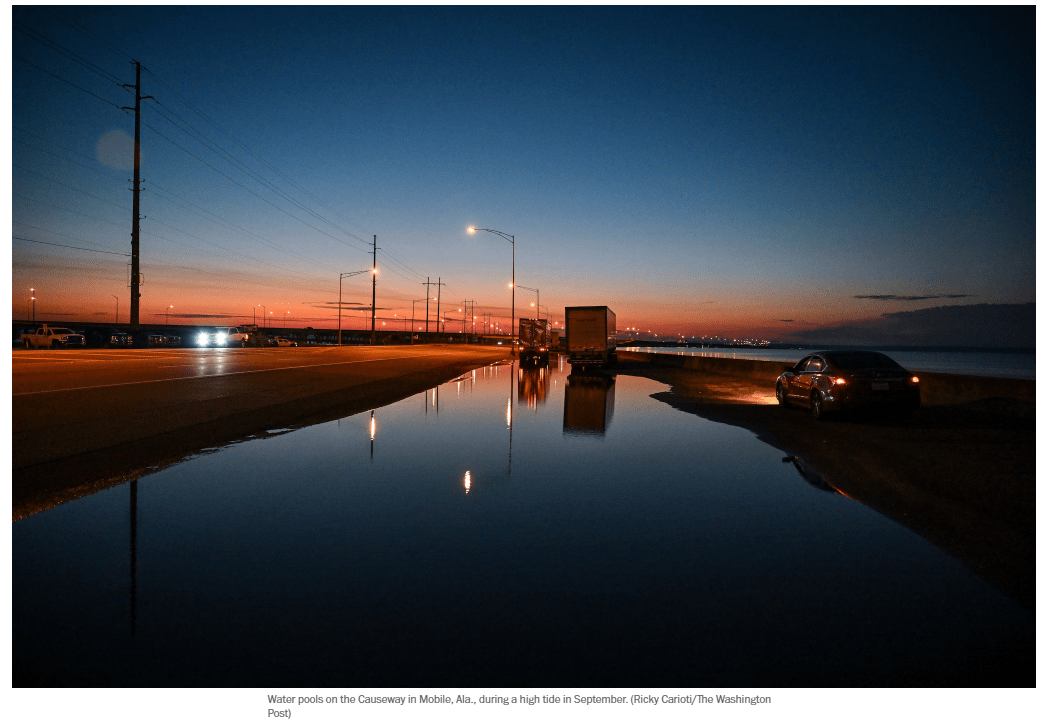
Here are glimpses at three spots along a roughly 200-mile stretch of the U.S. Gulf Coast that are already confronting this new reality:
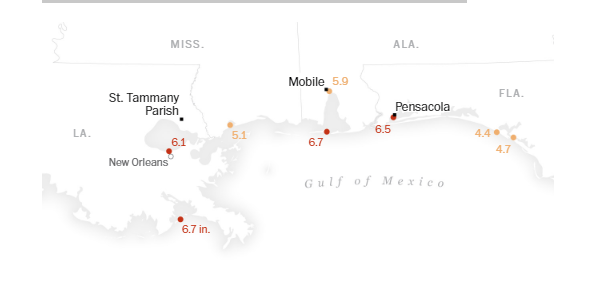
Mobile, Ala., 5.9 inches of sea level rise since 2010
THE INEQUITY OF RISING WATER
‘People of color are more likely to experience flooding’ — and the city is working to adapt.
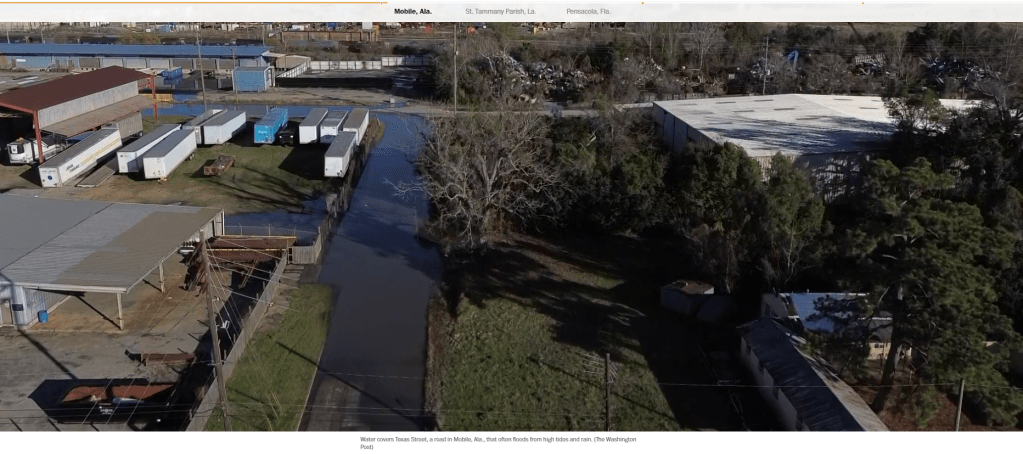
The inequities of the past and the changing threats of the present are colliding in this centuries-old port city.
Here, as in other cities, the legacy of unequal federal housing policies dating to the 1930s, known as redlining— a discriminatory practice that in particular targeted Black Americans — left minorityand low-income residents confined to certain areas. Over time, they faced the heavy burden of industrial pollution.Some of these same neighborhoods are now grappling with rising waters.
“The acknowledgment and acceptance of these historic inequities and their present-day impacts is a necessary, critical step,” city officials wrote in a recent report, adding: “[P]eople of color are more likely to experience flooding in Mobile.”
That’s partly due to relatively flat topography that allows higher water levels to travel farther inland and cause more severe flooding than in the past. The report said that many of the affected neighborhoods are low-lying and have decaying storm water systems, making them particularly vulnerable.
Rodneyka Lofton has lived in the same house on St. Emanuel Street, along a swath of Mobile’s heavily industrialized waterfront, for “a majority of my life,” she said.
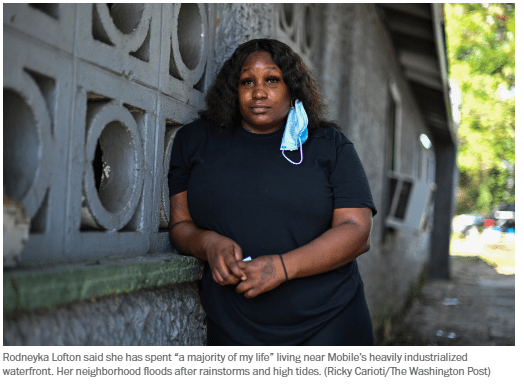
“Sometimes, it makes me feel not safe,” Lofton said one morning of the floodwaters that often submerge her street and other roads that lie about a quarter-mile from the Mobile River near where it ends at Mobile Bay.
“On my street, and on the back street over there, it looks like a small lake. And a lot of cars get stuck,” said Lofton, a nursing assistant. Only a handful of residents remain here, amid rows of semitrailers, a junkyard and a large container facility.
Along some areas of the Gulf and Atlantic coasts, recent research suggests, low-income and minority residents are likely to face a deepening burden as climate change fuels rising seas and more intense rainfalls.
“Flood risk is not borne equally by all,” wrote the authors of a 2022 study in the journal Nature Climate Change.In particular, they wrote, “The future increase in risk will disproportionately impact Black communities, while remaining concentrated on the Atlantic and Gulf coasts.”
Near Lofton’s home, recent data suggest the burden already is increasing.
The tide gauge at the nearby Mobile State Docks has registered about 6 inches of sea level rise since 2010.
Texas Street, around the corner from Lofton’s home, was once again inundated one morning earlier this year. A car was inching through deep water.
Rain had fallen the previous night, but the flooding was destined to linger due to high seas. A coastal researcher from the University of South Alabama, Bret Webb, had recently outfitted a sensor in one of the street’s drains. It showed that the base of the drain is now frequently lower than the waters in the Mobile River,preventing drainage.
As Mobile’s chief resilience officer, Casi Callaway works to gird the city’s residents and its infrastructure for the growing stresses posed by climate change and other challenges. She said Mobile has been steadily upgrading roads and the pipes beneath them — and aims to do so near Lofton’s home.
But she said it will take at least $30 million to fix drainage problems in an area where some storm water pipes are over a century old and made of wood. The city has applied for several grants to perform the work but has not yet received funding.

“Every dollar we invest should be a dollar spent preparing for what is coming,” said Callaway, who previously headed a local environmental group.
Over a century of history and memory also lie in the path of floodwaters.
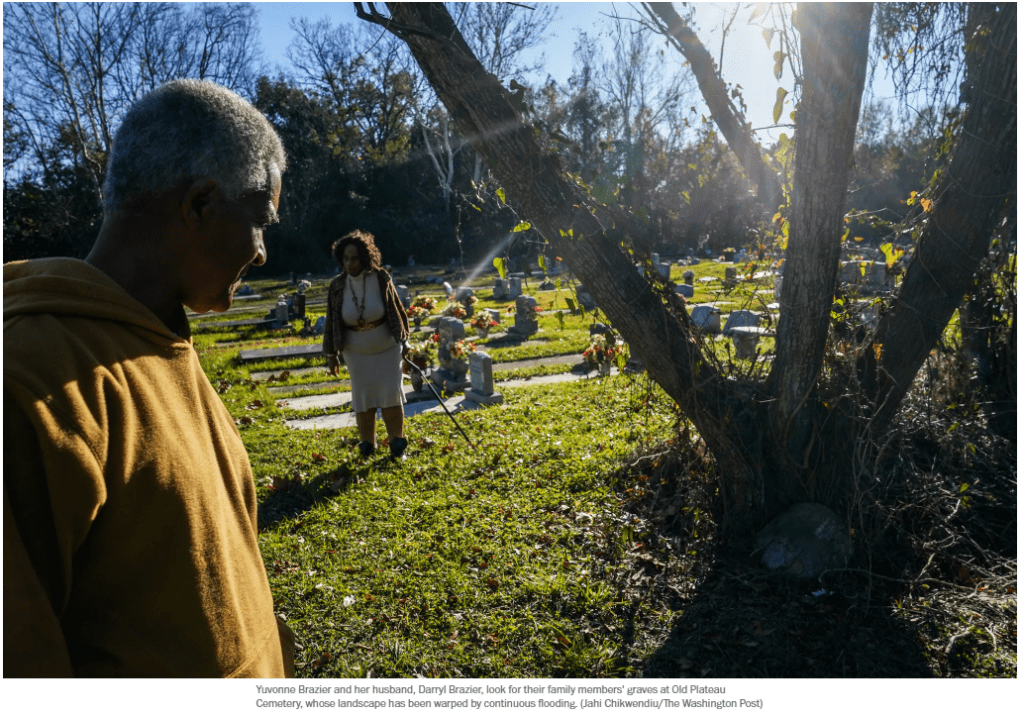
That is evident in the Old Plateau Cemetery in Africatown. The neighborhood in Mobile was founded by formerly enslaved people who arrived in 1860 on the Clotilda — the last known slave ship to leave Africa for the United States — and their descendants.
The historic burial ground dates to 1876, and appears to have been warped by sinking land and repeated flooding. Many graves now rest at angles. Some are sunken and fill regularly with rainwater, and those at the lowest-lying points are in disrepair.

While multiple factors probably play a role in the cemetery’s flooding problems, there are two ways rising seas can make them worse, said Alex Beebe, a geologist at the University of South Alabama who has studied the cemetery. As waters in Mobile Bay and the Gulf of Mexico rise, the water flowing downhill through Africatown to the coast will have more trouble escaping, he said. A higher ocean is also causing groundwater tables to rise, making it harder for rainfall to penetrate the soil.
For Yuvonne Brazier, the flooding is just part of a bigger inequity in Africatown, which alsois hemmed in by heavy industry.
Brazier’s grandfather and her sister, who died when she was young, are buried in the cemetery, along with many of the founders of the community.
But Brazier can no longer find the graves. She used to be able to sit on her mother’s front porch and see the cemetery where her loved ones were buried. That familiar landscape has grown less familiar over time.
“It’s all different now,” she said.
#Flooding, #Alabama, #Mississippi, #GulfOfMexico, #GulfCoast, #VintageDava
Follow Me at:
www.vintagedava.com
https://www.facebook.com/VintageDava/
https://www.instagram.com/vintagedava/
https://www.threads.net/@vintagedava
https://twitter.com/davagirl

