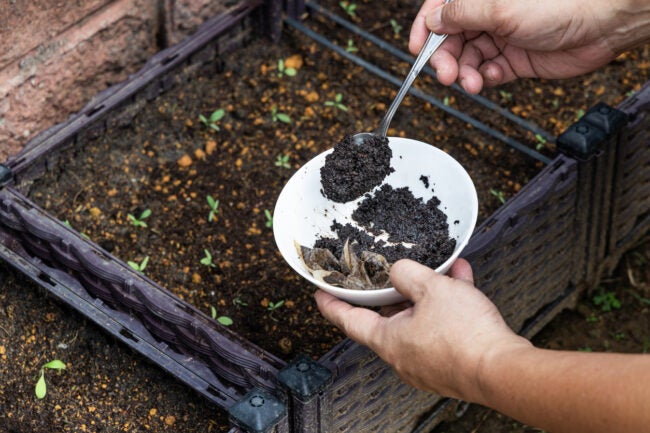
The use of coffee grounds for plants is grounded in fact, and it has several specific gardening benefits.
by Audrey Stallsmith
When considering how to use coffee grounds in the garden, keep in mind that they don’t acidify soil, contrary to popular belief. Although fresh coffee grounds are acidic, used grounds tend to be near neutral in pH. According to Oregon State University, “Coffee grounds are best at improving soil. As the coffee grounds feed the soil microbes, microbial glues are released that promote good soil structure and improve drainage.”
That means a simple DIY coffee ground fertilizer still has plenty to offer your garden despite not being able to move the needle on your soil’s pH balance. Here’s everything you need to know about using coffee grounds in the garden.
Benefits of Using Coffee Grounds in the Garden

Using coffee grounds is a common piece of DIY gardening advice, but are coffee grounds good for plants in the first place? Not always. Although they provide several benefits, they can suppress germination in alfalfa and clovers and growth in mustards, geraniums, asparagus ferns, and more, according to Linda Chalker-Scott of Washington State University. As for what plants like coffee grounds, you can safely apply them to beets, cabbage, soybeans, and anthuriums.
They improve soil structure.
As Chalker-Scott notes, composted coffee grounds can benefit garden soil directly. “The fact that earthworms pull coffee grounds deep into the soil may account for noted improvements in soil structure such as increased aggregation.” She explains that as coffee grounds degrade, they help produce substances that help form humus, or healthy and loose organic soil.
They add nutrients to the soil.
Composted coffee grounds will eventually add small amounts of nitrogen and micronutrients to the soil. However, they actually tie up nitrogen while they are breaking down, so don’t use coffee grounds as fertilizer unless they are thoroughly composted first or unless you supplement them with actual fertilizer.
They improve water retention in soil.
After they break down into compost in the garden, coffee grounds will cause the soil to retain more moisture. Whether or not that’s a benefit depends on how dry or wet your soil already is, as well as whether your plants might suffer from extra water retention.
They may suppress harmful fungi and bacteria.
The “good” fungi and bacteria found in composted coffee grounds may help fight off some of the “bad” ones, such as those that cause root rot. Among the bad fungi that decomposed coffee grounds can help suppress are Fusarium and Pythium.
A brew made from coffee can kill slugs.
Oregon State University research shows that using a 1 to 2 percent solution of coffee grounds mixed with water as a soil drench can eliminate slugs in the garden. A study found that 100 percent of slugs left coffee-treated soil and later died of caffeine poisoning, making it an effective natural slug killer.

The use of coffee grounds for plants is grounded in fact, and it has several specific gardening benefits.
FAQ About How to Use Coffee Grounds in the Garden
Q. Can I put coffee grounds directly on soil?
Yes, but use a thin layer and don’t leave them atop the soil or they’ll repel water. Work a ½-inch layer 4 inches into the soil or cover it with 4 inches of another mulch.
Q. Which plants do not like coffee grounds?
Coffee can inhibit germination of alfalfa and clovers and inhibit growth of mustards, geraniums, asparagus fern, etc.
Q. Do coffee grounds keep mosquitoes away?
There is no conclusive proof that coffee grounds or coffee-filled water can keep mosquitoes away.
Q. Do coffee grounds make soil acidic?
No. Although unused coffee grounds are acidic, used ones generally are only mildly so—not enough to change the pH of soil.
Q. Are coffee grounds good for potted plants?
No. They can cause an unhealthy buildup of soluble salts in the potting mix.
#VintageDava, #GardeningTips, #CoffeeGrounds, #Awareness, #Education, #HelpfulTips, #InterestingFacts, #SelfHelp, #Composting
https://vintagedava.blogspot.com/
https://www.tumblr.com/blog/vintagedava
https://www.facebook.com/VintageDava/
https://www.instagram.com/vintagedava/
https://www.threads.net/@vintagedava
 Vintage Dava