
by Kamaron McNair
If you find yourself having surgery in Tampa, Florida, Chabely Rodriguez’s face may be one of the last ones you see before you go under anesthesia.
The 28-year-old is a certified anesthesiologist assistant, which means she helps doctors keep patients comfortable and sedated when they have surgery or other medical procedures done. It’s a well-paying job that has allowed Rodriguez to pursue the medical career she always dreamed about without having to go to medical school.
“Growing up, I loved science, that was my favorite subject — chemistry in particular,” she tells CNBC Make It. “I loved the critical thinking behind it, and I wanted to pursue a career in medicine.”
In only her second full year as a CAA, Rodriquez is earning over $200,000 annually between her base salary of $198,000 and the overtime shifts she typically picks up. In 2022, she pulled in over $210,000 and she’s on track to earn even more this year.
Farm to operating table
Though she’s close with her family, it was difficult breaking the news to her parents that she didn’t want to continue working on the farm beyond high school, Rodriguez says.
“I believe their dream was for us to continue the business as adults in some capacity,” she says. “However, my dreams were not to be a farmer.”
Rodriguez stayed in New York to pursue her undergraduate degree at Brooklyn College, where it would be more affordable because it’s a public school and she could continue living at home. Her parents helped some, and she applied for scholarships, allowing Rodriguez to earn her bachelor’s without taking on student debt.
She studied chemistry on a pre-med track, but after she graduated, Rodriguez realized the time and cost of medical school weren’t commitments she wanted to make.
“I started looking more into physician assistants, something with similar responsibilities [as a doctor], but with a shorter timeline and typically less debt,” she says. “It would be less compensation, but I felt like it was worth it for the time that I was exchanging for it.”
Her passion for chemistry and interest in anesthesia led Rodriguez to learning about anesthesiologist assistants. After researching the career and shadowing CAAs to get a sense of the work, she knew it was the path for her.
‘I work with a lot of needles’
Even if you’re fairly familiar with surgery procedures, you may have never encountered a CAA. Currently, CAAs are only able to practice in 20 states and the District of Columbia, which is part of the reason Rodriguez currently lives and works in Florida.
Though her job is all about making patients feel comfortable and pain-free, it’s not exactly for the faint of heart.
“I work with a lot of needles, drawing up medicines,” Rodriguez says. “I place IVs on patients, I can place arterial lines, needles for epidurals, needles for blocks which will numb up local areas of a patient.”
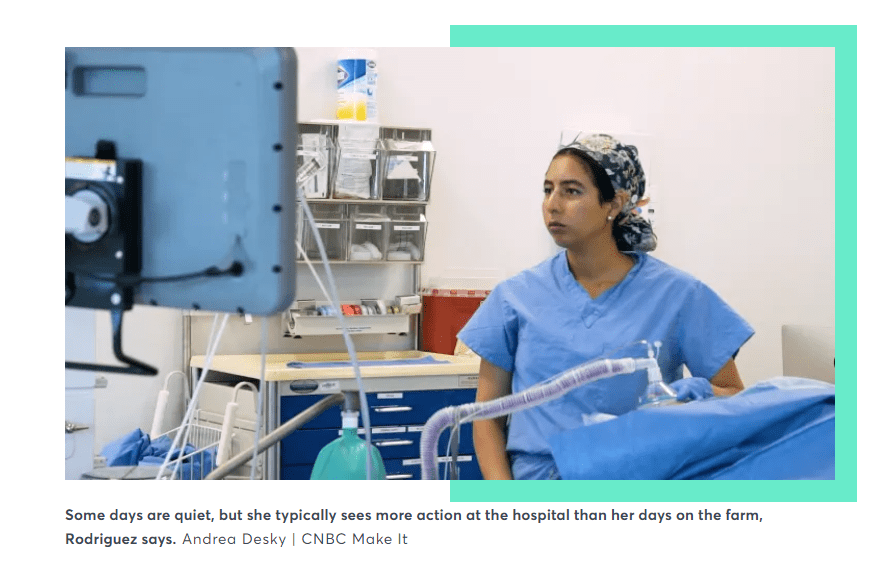
A typical day can have Rodriguez seeing anywhere between one and 14 patients, she says, depending on the length of each procedure and what’s on the hospital’s schedule.
“The pace is so fast, but I love it,” Rodriguez says. “I feel like it just keeps pushing me to be better and faster and smoother with what I decide to do for patient care.”
In fact, working with patients is one of the highlights of her work.
“My favorite part of the job is waking patients up and seeing how comfortable they are at the end,” Rodriguez says. “They wake up and they are surprised that the surgery is done, that they’re already awake and recovering.”
From six figures in debt to a six-figure salary
After undergrad, Rodriguez went to Nova Southeastern University in Fort Lauderdale, Florida, to earn her master’s degree in anesthesiology, which allowed her to then get her CAA credentials.
But unlike her undergraduate studies, Rodriguez had to take out loans for graduate school — a total of around $200,000 for the two-year program.
But “given that the salary would be around $150,000, I still pursued the profession knowing I would go into debt,” she says. “I felt like I had a realistic chance of paying it off within five years.”
She wouldn’t even need five years.
Rodriguez wound up not needing the entire $200,000 to pay for school, and eventually paid back $127,590 in total.
She hustled to start working right away after graduation. She was able to get expedited credentialing through a hospital that allowed her to start working — and earning — as a CAA faster. Within three months of graduating, she had secured a six-figure salary.
When the Covid-19 pandemic hit and former President Donald Trump enacted the forbearance on federal student loan payments and interest, Rodriguez saw an opportunity. Instead of continuing to pay down her debt, she put her monthly payments into a high-yield savings account.
By the time the pause was about to end in September 2023, she had more than enough savings to wipe out her debt, and that’s exactly what she did. All in, she paid off her six-figure debt in about two years.
She would have liked to be able to put that money toward her investments or just enjoying life, “but I knew going into school that I had to pay this debt off … and I felt like it was worth the amount that I had to pay,” Rodriguez says.
How she spends her money
Even after paying off her debt, Rodriguez has continued to save around 50% of her income. Partly because she wants to be able to travel freely and save for her eventual retirement, but also because of how she grew up.
Rodriguez says growing up without a lot of money left her with a bit of a “scarcity mindset,” to the point where even though she’s saving a lot, she’s still nervous about worst-case scenarios like losing her job.
“I just feel like I always want to prepare for that,” she says. “I’ve worked a lot of overtime hours just to make sure that I always have something extra.”
Here’s how Rodriguez spent her money in September 2023:
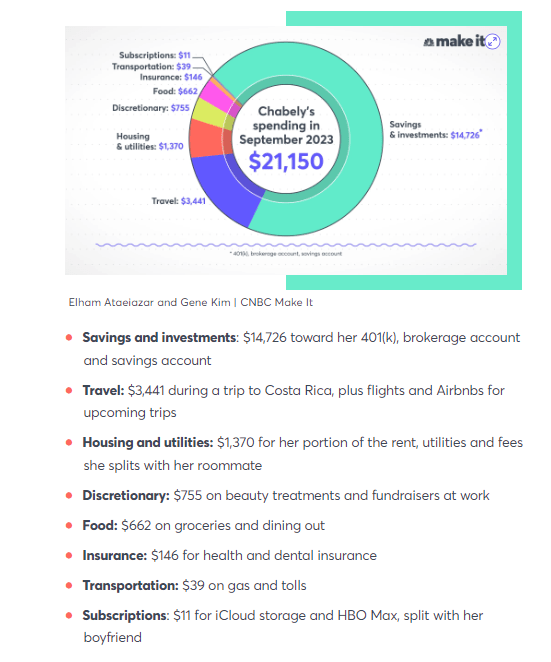
Her monthly income was higher than usual in September because she received three paychecks, which covered a raise as well as overtime and hazard pay. Rodriguez keeps her monthly costs relatively low by paying lump sums for things like her car and renters insurance, which she pays at six-month and annual intervals, respectively.
She puts most of her expenses for things like groceries and travel on credit cards in order to reap the rewards, but pays them off in full each month, carrying no debt.
Outside of her rent and savings, traveling is her biggest expense, and Rodriguez sticks to a budget to ensure she’s able to take the trips she wants to. She could afford to live on her own, but she’s gotten comfortable living with a roommate, which keeps her living costs low. She also drives an economical Toyota Corolla.
“I could get a more luxurious car, I could also live in a nicer apartment, or live on my own, but those are things that are not a priority for me,” Rodriguez says. “I try to save on the things that aren’t as important to me, but I spend on the things that matter to me, like food and experiences when I go to a different country.”
‘Luxury would be a first-class ticket’
Though she’s not planning to retire early, Rodriguez does plan to slow down a bit in the near future.
She’s looking forward to cutting back on some of her overtime shifts and spending more time pursuing her other hobbies, like working out and creating content for her YouTube channel. Rodriguez posts videos to the platform raising awareness about the CAA profession and showing the world what her career is like.

When she was starting to research CAAs, Rodriguez says she didn’t see a lot of representation online or CAAs talking about what they do.
“I do my best to set that example,” she says.
In terms of financial goals, she’s not looking to buy a home anytime soon. She’s still prioritizing traveling both to visit with her family in New York and explore more of the world. Her siblings currently live in various locations around the globe, so she’s excited to travel with them to Mexico later this year and to visit her brother in Japan next year.
“I just want to keep my cost of living low, but spend the money on making travel more comfortable between the different states,” Rodriguez says. “For me, luxury would be maybe getting a first-class or a business-class ticket for a long flight.”
#VintageDava, #Relationships, #Awareness, #College, #CrazyTimes, #Drama, #Education, #HelpfulTips, #InterestingFacts, #SelfHelp, #SocialMedia, #UnitedStates
Connect with Me At:
https://vintagedava.blogspot.com/
https://www.tumblr.com/blog/vintagedava
https://www.facebook.com/VintageDava/
https://www.instagram.com/vintagedava/
https://www.threads.net/@vintagedava
 Vintage Dava