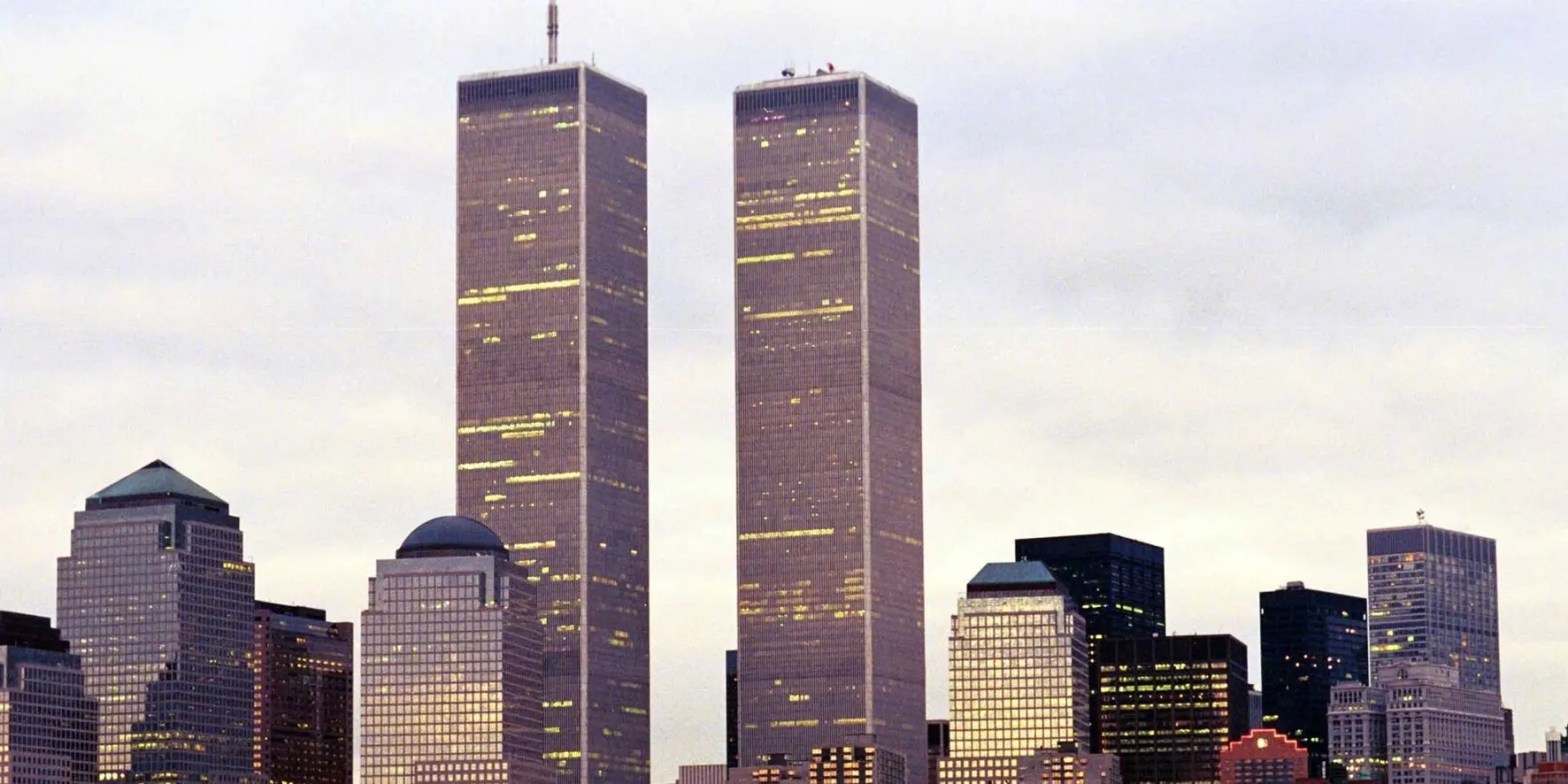
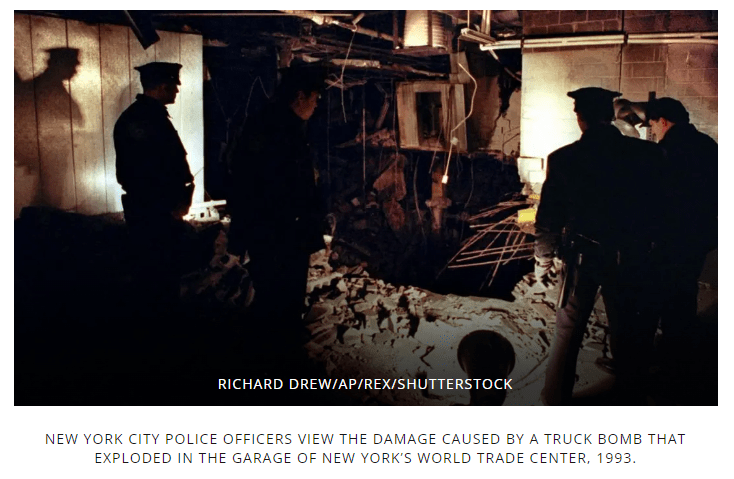
2/26/1993 At 12:18 p.m., a terrorist bomb explodes in a parking garage of the World Trade Center in New York City, leaving a massive, multi-story crater and causing the collapse of several steel-reinforced concrete floors in the vicinity of the blast.
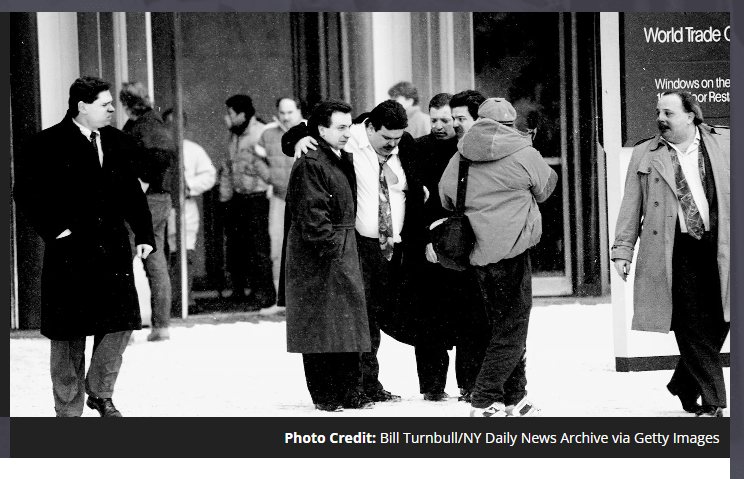
Although the terrorist bomb failed to critically damage the main structure of the skyscrapers, six people were killed and more than 1,000 were injured. The World Trade Center itself suffered more than $500 million in damage. After the attack, authorities evacuated 50,000 people from the buildings, hundreds of whom were suffering from smoke inhalation. The evacuation lasted the whole afternoon.
City authorities and the Federal Bureau of Investigation (FBI) undertook a massive manhunt for suspects, and within days several radical Islamic fundamentalists were arrested. In March 1994, Mohammed Salameh, Ahmad Ajaj, Nidal Ayyad, and Mahmoud Abouhalima were convicted by a federal jury for their role in the bombing, and each was sentenced to life in prison. Salameh, a Palestinian, was arrested when he went to retrieve the $400 deposit he had left for the Ryder rental van used in the attack. Ajaj and Ayyad, who both played a role in the construction of the bomb, were arrested soon after. Abouhalima, who helped buy and mix the explosives, fled to Saudi Arabia but was caught in Egypt two weeks later.
The mastermind of the attack—Ramzi Ahmed Yousef—remained at large until February 1995, when he was arrested in Pakistan. He had previously been in the Philippines, and in a computer he left there were found terrorist plans that included a plot to kill Pope John Paul II and a plan to bomb 15 American airliners in 48 hours. On the flight back to the United States, Yousef reportedly admitted to a Secret Service agent that he had directed the Trade Center attack from the beginning and even claimed to have set the fuse that exploded the 1,200-pound bomb. His only regret, the agent quoted Yousef saying, was that the 110-story tower did not collapse into its twin as planned—a catastrophe that would have caused thousands of deaths.
Eyad Ismoil, who drove the Ryder van into the parking garage below the World Trade Center, was captured in Jordan that year and taken back to New York. All the men implicated had ties to Sheik Omar Abdel Rahman, a radical Egyptian religious leader who operated out of Jersey City, New Jersey, located just across the Hudson River from Manhattan. In 1995, Rahman and 10 followers were convicted of conspiring to blow up the United Nations headquarters and other New York landmarks. Prosecutors argued that the World Trade Center attack was part of that conspiracy, though little clear evidence of this charge was presented.
In November 1997, Yousef and Ismoil were convicted in a courtroom only a few blocks away from the twin towers and subsequently sentenced to life in prison without the possibility of parole. Only one other man believed to be directly involved in the attack, Iraqi Abdul Rahman Yasin, remains at large.
After the 1998 bombings of U.S. embassies in Kenya and Tanzania, U.S. investigators began to suspect that Yousef had ties to Saudi exile Osama bin Laden, the head of the anti-U.S. al Qaeda terrorist network. Whether bin Laden was in fact involved in the 1993 Twin Tower attacks has not been determined, but on September 11, 2001, two groups of al Qaeda terrorists finished the job begun by Yousef, crashing two hijacked airliners into the north and south tower of the World Trade Center.
The structural steel of the skyscrapers could not withstand the tremendous heat generated by the burning jet fuel, and both collapsed within two hours of being struck. Close to 3,000 people died in the World Trade Center and its vicinity, including a staggering 343 firefighters and 23 policemen who were struggling to complete the evacuation and save the office workers trapped on higher floors. Only six people in the World Trade Center towers at the time of their collapse survived. Almost 10,000 other people were treated for injuries, many severe.
7 Facts About the 1993 World Trade Center Bombing
by Sarah Pruitt
Eighteen minutes after noon on February 26, 1993, a bomb exploded in the basement parking garage below the north tower of the World Trade Center. The massive explosion killed six people and wounded more than 1,000, with some 50,000 people forced to evacuate the twin towers as smoke and flames spread upward into the buildings.
The bombing brought home the shocking new reality of radical Islamic terrorism as a global phenomenon that directly impacted the United States and its citizens. The planned scale of the attack dwarfed previous terrorist plots, as the plot’s leader, Ramzi Yousef, later told the FBI he had hoped to topple one tower into the other, killing some 250,000 civilians. Tragically, the 1993 bombing foreshadowed the much larger attack on the World Trade Center on September 11, 2001, in which a different group of Muslim extremists would achieve at least part of Yousef’s horrific goal.
1. The bomb blasted a massive crater several stories deep underneath the World Trade Center.
Loaded with around 1,300 pounds of urea nitrate (an explosive material made from fertilizer) and hydrogen gas cylinders, along with cyanide, the bomb exploded inside a yellow Ryder van parked on the B-2 level of the parking garage under the North Tower. The massive blast killed six people near the bomb site and injured more than 1,000, with most of those suffering from smoke inhalation during evacuation from the towers.
2. While searching through 4,000 pounds of rubble, investigators found a key clue about its perpetrators.
Within minutes of the explosion, members of the New York Joint Terrorism Task Force (JTTF) headed to the World Trade Center, where they would coordinate an investigation including the Federal Bureau of Investigation (FBI) and New York Police Department (NYPD) among other federal, state and municipal government agencies. The FBI and JTTF had been tracking Islamic fundamentalists in the city for months before the attack and immediately suspected this was an act of terrorism. The day after the attack, agents searching the wreckage found several parts of a vehicle that apparently exploded from the inside out. Two of the pieces showed a vehicle identification number (VIN), which investigators traced to a van that had been reported stolen on the day before the attack at a rental agency in Jersey City, New Jersey.
3. By the time the towers reopened in late March 1993, authorities had arrested four suspects.
When Mohammed Salameh, the man who had rented the van, returned to the rental agency on March 4 to try to get his $400 deposit back, an FBI team arrested him. Things unfolded quickly from there: FBI investigators found bomb-making chemicals that matched evidence found at the World Trade Center in a self-storage unit in Jersey City, while The New York Times received a letter claiming responsibility for the attack from a group called the Liberation Army, Fifth Battalion. A search of Salameh’s apartment led to the arrests of three more suspects, including Nidal Ayyad (whose DNA matched saliva on the letter’s envelope), Mahmud Abouhalima and Ahmed Ajaj. Investigators questioned another suspect, Abdul Yasim, but released him due to a lack of evidence; he subsequently fled the country and has never been captured.
4. Their leader remained at large for two years.
While Salameh, Ayyad, Abouhalima and Ajaj were tried, convicted and sentenced to life in March 1994, the man identified as the plot’s mastermind had escaped to Pakistan immediately after the bombing. Over the next two years, Ramzi Yousef took part in various other terrorist actions, including planting a bomb on a commercial airplane in the Philippines in order to test a larger plot involving explosions on as many as a dozen U.S. planes. Captured in February 1995, Yousef was extradited to New York City, tried and found guilty of both the bombing and the Manila plane plot, code-named “Bojinka.” He was sentenced in January 1998 to life in prison plus 240 years, with the judge factoring in combined life expectancies of the six people killed in the 1993 bombing. Yousef was unapologetic, claiming he wanted to punish the United States for its role in providing aid to Israel. “Yes, I am a terrorist and proud of it,” he told the court.
5. Several of the WTC bombers were connected to the same mosque, led by an influential extremist cleric known as the ‘Blind Sheikh.’
The arrests of Salameh, Abouhalima and Ayyad led FBI investigators to a Brooklyn mosque all three had attended, and to Sheikh Omar Abdel Rahman, a radical Sunni Muslim cleric who had emigrated to the United States in the early 1990s. Abdel Rahman, who lost his eyesight at a young age, espoused a fundamentalist brand of Islam that condemned secular Muslims, Western materialism and U.S. support for Israel and Egypt. In the early 1980s, he had been tried and acquitted twice for instigating the assassination of that country’s president Anwar Sadat.
6. Several months after the bombing, investigators foiled another terrorist plot against major New York City landmarks.
In June 1993, as part of an ongoing surveillance operation, an FBI camera caught a group of men constructing a bomb in a garage in Queens, New York. Authorities subsequently arrested Abdel Rahman and nine of his followers and charged them with planning to simultaneously bomb the United Nations headquarters, the George Washington Bridge, and the Holland and Lincoln Tunnels, among other targets. They were found guilty and sentenced to life in prison in late 1995. Even behind bars, Abdel Rahman continued to exert a powerful influence on radical Muslims. Peter Bergen, a journalist and biographer of Osama bin Laden, described him as the “spiritual guide of 9/11.”
7. The 1993 bombing proved to be a deadly dress rehearsal for 9/11.
By early 1996, U.S. authorities had determined that Ramzi Yousef’s uncle, Khalid Sheikh Mohammed, had plotted with his nephew to bring down the planes in the “Bojinka” plot and wired him money before the first World Trade Center bombing. But KSM (as he was known) evaded capture and rose in the ranks of the militant Islamic group al Qaeda to become one of bin Laden’s top lieutenants. As the “principal architect” of the terrorist attacks of 9/11, KSM succeeded where his nephew had failed, orchestrating the destruction of the twin towers and the mass murder of thousands of civilians on U.S. soil.
#VintageDava, #History, #Awareness, #HistoricalFacts, #HistoricalTuesdays, #InterestingFacts, #LivesDestroyed, #Tragedy, #UnitedStates, #WorldTradeCenter
Connect with Me At:
https://www.tumblr.com/blog/vintagedava
https://www.facebook.com/VintageDava
https://www.instagram.com/vintagedava
https://www.threads.net/@vintagedava
 Vintage Dava